CURATORIAL THESIS
What if colour is not something we see, but something through which we perceive?
Women Sage · Transcendental Art · The Healing Intelligence of Colour
For centuries, women have used colour not merely to represent the visible world. They used it to investigate worlds that could not yet be seen. Psychological. Spiritual. Energetic. Cosmic.
The Colour of the Unseen explores a remarkable lineage of women artists. They turned away from the visible world. They turned toward another territory: consciousness, intuition, spiritual experience, the body, nature, and forces that could be sensed but not easily represented.
This exhibition, in partnership with Bridgeman Art, brings together Georgiana Houghton, Hilma af Klint, Emma Kunz, Agnes Pelton, Leonora Carrington and Remedios Varo. Selected contemporary voices join them. Together they trace a passage from nineteenth-century early abstraction through sacred geometry and surrealism to contemporary practices of perception.
Although separated by geography and generation, these women shared a radical proposition. Art could be an instrument for knowing. For them, colour was rarely decorative. It became vibration, symbol, psychological state, spiritual language, diagram, medicine, atmosphere, or portal.
BEFORE ABSTRACTION HAD A NAME
A hidden lineage
The canonical story has gaps.
The conventional history of modern abstraction long centred on Kandinsky, Malevich and Mondrian. Yet decades before abstraction entered the canon, Georgiana Houghton was producing extraordinary non-representational watercolours. She worked through spiritualist practice.
In Sweden, Hilma af Klint developed an immense vocabulary. Spirals. Circles. Botanical forms. Polarity. Luminous colour. She attempted to map spiritual evolution and dimensions beyond ordinary perception.
Her paintings were not illustrations of mystical ideas. They were attempts to make invisible systems visible.
In Switzerland, Emma Kunz went further. She was artist, researcher and healer. She used a pendulum to construct extraordinarily precise geometric drawings. These were instruments of investigation. Through them, relationships between human beings, nature and energetic forces might be understood.
Both artists sensed that their work was made for a future century. They were pioneers before the language of abstraction existed.
Not abstraction as the reduction of visible reality, but abstraction as the visualization of invisible reality.
COLOUR AS KNOWLEDGE
Colour as a field of knowing
What can colour know?
The exhibition begins with a question. What did these women believe colour could know? We do not assign fixed therapeutic meanings. Red for vitality. Blue for calm. Green for healing. Instead, we approach colour as an unstable and powerful field between the external and internal worlds.
Colour is both physical and perceived.
Colour exists physically as light. But colour is also produced through perception. It enters memory. It carries cultural and spiritual symbolism. It changes through proximity to other colours. And it can alter our experience of space, time and our own bodies.
Each artist developed her own colour grammar.
For Agnes Pelton, light and colour became languages for silence and interior experience. For af Klint, colour participated in systems of polarity and spiritual evolution. For Kunz, colour lived inside geometric relationships. For Carrington and Varo, colour inhabited alchemical, psychological and mythological worlds. There, transformation itself became the subject.
Art becomes less an object to contemplate than a technology of attention.
FROM MYSTICISM TO HEALING
Healing is not cure
A distinction between healing and cure.
The exhibition deliberately distinguishes between healing and cure. It does not claim that particular colours medically treat particular conditions. It asks a more profound question. Can an encounter with art change our state of being?
Healing as restored relationship.
Healing, here, means restoring relationship. Between sensation and consciousness. Between body and imagination. Between the individual and nature. Between rational and intuitive knowledge. Between what can be measured and what can only be experienced.
Outside the institutions.
Some of these women were mediums. Some were healers. Some studied esoteric traditions, dreams, alchemy, mathematics, botany or cosmology. Many worked outside the institutions that determined what counted as legitimate art or legitimate knowledge.
Who has the authority to define what counts as knowledge?
WHY NOW?
The urgency of embodied perception
Machines can see. Can we still feel?
We are entering an era dominated by artificial intelligence, computational vision and unprecedented quantities of images. Machines can increasingly recognize, classify and generate what is visible.
Another intelligence is needed.
Yet this acceleration makes another human capacity newly urgent. The ability to perceive what cannot immediately be quantified. Intuition. Embodied knowledge. Attention. Inner experience. Relationship. Meaning.
The past speaks to the present.
These women were exploring such territories long before today's language of consciousness, systems thinking and embodied intelligence emerged. Their work suggests that technological progress does not eliminate mystery. It may make our relationship with mystery more important.
Perhaps these artists were developing another form of intelligence — capable of moving between rationality and intuition, geometry and imagination, matter and consciousness.
IMMERSION: FROM VIEWER TO PARTICIPANT
The visitor completes the work
The final gesture is yours.
The final gesture belongs not to the artists but to the visitor. After encountering more than a century of attempts to visualize invisible worlds, visitors enter a contemplative colour environment.
Nothing to achieve. Only to be present.
There is nothing to understand. Nothing to diagnose. Nothing to achieve. Only colour, light, space, breath and time.
The exhibition begins with make the invisible visible. It ends by turning the question inward: what becomes visible when we learn to perceive differently?
EXHIBITION JOURNEY
Five chapters of a perceptual journey.
- I
RECEIVING
The Artist as InstrumentGeorgiana Houghton · Hilma af Klint · Anna Cassel
Creation does not always begin with conscious intention.
THE ARTIST BECOMES RECEIVER
- II
MAPPING
Geometry of the InvisibleHilma af Klint · Emma Kunz
Form given to relationships that cannot otherwise be seen.
THE ARTWORK BECOMES MAP
- III
VIBRATION
Colour as EnergyEmma Kunz · Agnes Pelton · Hilma af Klint
Colour leaves the surface of the painting and enters the body of the viewer. HEALING ≠ CURE. Colour is relationship.
THE ARTWORK BECOMES FIELD
- IV
ALCHEMY
Transformation and the Feminine ImaginalLeonora Carrington · Remedios Varo · selected visionary artists
Alchemy as both material and psychological transformation.
THE ARTWORK BECOMES PORTAL
- V
PRESENCE
From Looking to SensingHistorical works in dialogue with contemporary practices
The visitor is no longer simply looking at art. The visitor becomes part of the perceptual experiment.
THE ARTWORK BECOMES EXPERIENCE
VIRTUAL IMPACT: At Presence of Her
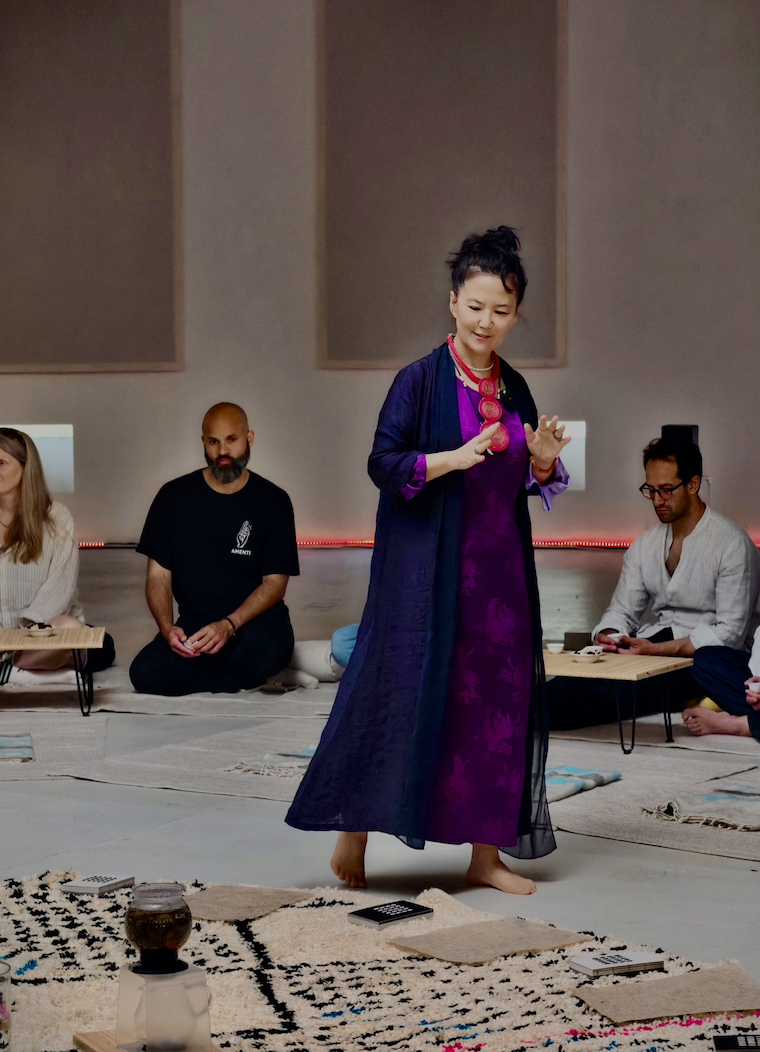
Bring Hilma af Klint, Emma Kunz, Agnes Pelton or Georgiana Houghton into an immersive tea room. Visitors spend time with the person behind the works. Unobtrusive sensors record the response.
- HR + HRV
- Autonomic regulation
- EDA / GSR
- Arousal
- RESPIRATION
- Breathing pattern
- EEG
- Alpha / theta / beta dynamics
- fNIRS
- Prefrontal & visual-cortex haemodynamics (optional)